
Position Statements
MVMA Position Statements on Issues Impacting Animal Welfare and Veterinary Medicine
Below are MVMA’s Position Statements on a variety of topics. Please note that no MVMA position statement shall be construed as support or opposition to any particular piece of legislation or administrative rule.
Animal abuse ranges from minor neglect to willful and malicious intent to harm. Animal abuse is often an indicator of other forms of violence and studies have shown that there is a correlation between animal and human abuse. While neglectful acts may be unintentional and related to ignorance or lack of education, intentional forms of animal abuse cannot be tolerated.
Since veterinarians have a responsibility to both animals and the public, and may be the first contact with an abused animal, they should take an active role in detecting, recognizing, preventing, and reporting animal abuse.
The veterinary profession should educate its members to recognize, document and report animal abuse, develop forensic models, discuss legislation concerning reporting by veterinarians, and collaborate with other animal and human welfare groups and professionals within communities to eliminate animal abuse.
The MVMA recognizes that veterinarians have a commitment not only to animal health and welfare, but also to the promotion of public health and advancement of medical knowledge. The MVMA supports the humane and responsible use of animals in education, research, and outreach. Furthermore, the MVMA supports the policies and procedures used by institutional animal use and care committees to assure animals are used judiciously and treated humanely.
The MVMA supports the practical application of the “Three Rs” in research as guiding principles for more ethical use of animals in testing. These were first described by W.M.S. Russell and R.L. Burch. The Three Rs are:
- Replacement of animals in research whenever possible
- Reduction of the number of animals used in research
- Refinement of research protocols to minimize pain and distress, as well as to maximize the welfare of such animals used in research.
The MVMA supports strict enforcement of the regulations addressing the use of animals in education, research and outreach, and encourages adequate funding for enforcement of regulations. Furthermore, the MVMA promotes the continued review and modification of these regulations.
The MVMA encourages its members to view, evaluate, and treat all persons in any professional activity or circumstance in which they may be involved, solely as individuals on the basis of their own personal abilities, qualifications, and other relevant characteristics.
The MVMA confronts and rejects all forms of prejudice and discrimination that have led to misunderstanding, hostility and injustice. These include, but are not limited to, those based on race, ethnicity, gender, disability, sexual orientation, gender identity, parental status, religious beliefs, military or veteran status, political beliefs, geographic, socioeconomic, and educational background and any other characteristic protected under applicable federal or state law.
The MVMA believes that all animals, including homeless and shelter dogs and cats, should be treated humanely and with dignity and respect and recommends that shelters develop an ongoing relationship with a licensed veterinarian.
Euthanasia should only be performed by trained individuals using commercially manufactured euthanasia solution. Stress and anxiety should be minimized by the use of pre-euthanasia sedation when necessary and sedatives should be incorporated into the euthanasia protocol.
For adult dogs and cats it is preferred that euthanasia solution should be given intravenously; intraperitoneal injection is acceptable for cats, kittens, and small puppies.
Intra-cardiac injection of euthanasia solution is only acceptable if the animal is unconscious or anesthetized. The use of carbon dioxide or carbon monoxide gas for euthanasia of shelter dogs and cats is not acceptable.
All Michigan cats should be vaccinated against rabies. Rabies remains one of the most important zoonotic diseases in Michigan and the United States. Zoonotic infections can be of great importance because of high incidence, contagiousness, morbidity or mortality. Rabies is considered to be universally fatal.
All mammals are susceptible to rabies virus infection and potentially capable of transmitting it to humans. Every year dozens of animals test positive for rabies virus infection in Michigan. For at least the last 25 years, the domestic animal in both the United States and Michigan to most commonly test positive for rabies has been the cat, with 3-4 times more infected cats reported annually than dogs in the United States.
Vaccination of domestic animals, especially cats and dogs, is crucial. Vaccinated pets are a protective barrier between the people who own and interact with them and rabid wild animals with which their pets might have contact. Rabies vaccines of almost 100% efficacy are available for cats 3 months of age and older. We recognize there are some cats in which the public has an interest, but ownership is not established, e.g. farm or feral cats.
The Michigan Veterinary Medical Association recommends that all cats be vaccinated against rabies.
Approved by the MVMA Board of Directors on June 11, 2026
The MVMA supports the pasteurization of milk intended for human consumption. Pasteurization, combined with sound agricultural and processing practices, is a proven public health measure that significantly reduces the risk of foodborne illness. The association between raw milk consumption and foodborne illness is well documented in the scientific literature and its consumption has been opposed by every major health organization in the country. Vulnerable populations, including young children, older adults, pregnant women, and immunocompromised individuals, are particularly at risk for severe health outcomes.
Michigan veterinarians recognize the importance of Michigan’s strong and diverse agricultural economy and acknowledge the role of local and small-scale dairy markets in supporting farmers and providing consumers with locally produced food. At the same time, maintaining rigorous food safety standards is essential to sustaining consumer confidence in dairy products and the dairy industry. While improved sanitation, testing, and labeling may reduce some risks, the MVMA recognizes that the risk of pathogen exposure cannot be eliminated without pasteurization.
The MVMA supports policies that protect both public health and Michigan’s agricultural community and recognizes pasteurization as the most effective measure for safeguarding both. This position reflects the well-established risk of pathogen exposure associated with raw milk, the lack of demonstrated nutritional benefit, the health care and taxpayer costs associated with treatment and outbreak response, and the potential damage to consumer confidence in the dairy industry.
Sources
AABP Position Statement: Consumption of Unpasteurized (Raw) Milk
https://www.aabp.org/resources/AABP_Position_Statements/raw_milk_2023.pdf
2024 AASRP Raw Milk Guidelines
https://aasrp.org/common/Uploaded%20files/Guidelines/2024%20AASRP%20Raw%20Milk%20Guidance.pdf
NMC Position Statement: Consumption of Raw Unpasteurized Milk
https://www.nmconline.org/wp-content/uploads/2020/09/NMC-Position-Statement-raw-milk-FINAL-2020.pdf
NMPF and IDFA Letter to Congress May 14, 2018
https://www.nmpf.org/wpcontent/uploads//files/FINAL%20NMPF%20IDFA%20Letter%20on%20Massie%20Raw%20Milk%20Amendment%2005%2014%202018.pdf
FDA Website – Raw Milk Misconceptions and the Danger of Raw Milk Consumption
https://www.fda.gov/food/buy-store-serve-safe-food/raw-milk-misconceptions-and-danger-raw-milk-consumption
AVMA Policies: Raw Milk
https://www.avma.org/resources-tools/avma-policies/raw-milk
Costard S, Espejo L, Groenendaal H, Zagmutt FJ. Outbreak-Related Disease Burden Associated with Consumption of Unpasteurized Cow's Milk and Cheese, United States, 2009-2014. Emerg Infect Dis. 2017 Jun;23(6):957-964.
https://pmc.ncbi.nlm.nih.gov/articles/PMC5443421/
Cornell Food Science Department: Position Statement on Raw Milk Sales and Consumption
https://cals.cornell.edu/sites/default/files/2023-04/cu-dfscience-notes-raw-milk-position-statement-rev-4-20.pdf
Pet Spotlight
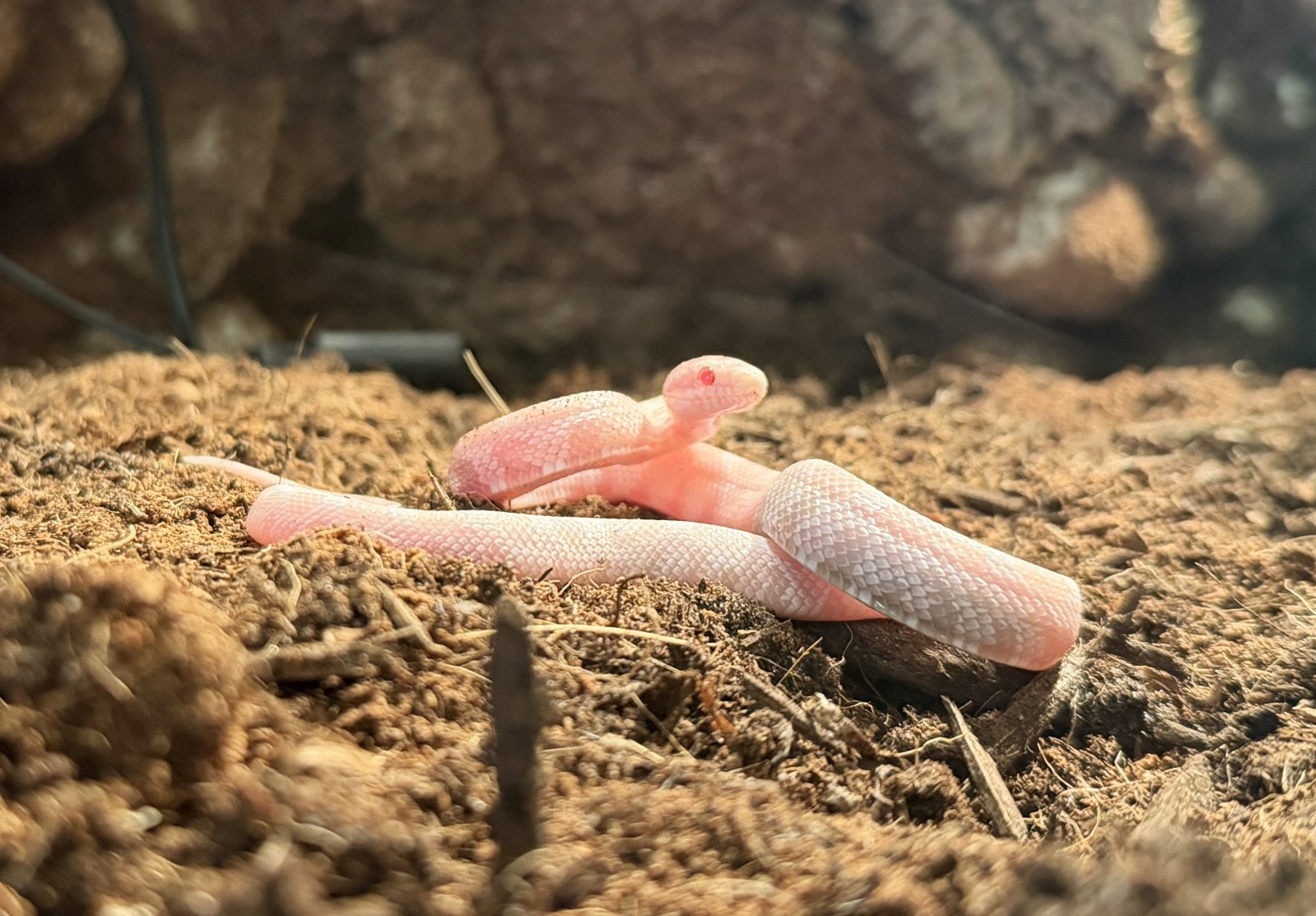
Bennie, a corn snake owned by Gail Wolfe's Bennett Road Animal Clinic.
"Reptiles and amphibians are sometimes thought of as primitive, dull and dimwitted. In fact, of course, they can be lethally fast, spectacularly beautiful, surprisingly affectionate and very sophisticated."
--David Attenborough